
DJing In Schools and The Rise of the Digital Musician
Dr Jonathan Savage
Founder and Director of UCanPlay, the leading not-for-profit music education supplier for schools and colleges
Regional Programme Director, Restore the Music.
General Market Analysis
The UK DJ‐equipment market (controllers, mixers, turntables) is estimated at about £21 million in 2025 and is forecast to grow c.6% per year over the next four years.
This is against a background of declining sales in similar markets here in the UK, e.g. the broader audio/video equipment retail market (c.£469 m in 2025) is shrinking at c.3% year on year.
The UK DJ‐equipment sector appears to be growing, though from a relatively small base, and at a moderate pace. Specific sales data relating to core brands (e.g Pioneer, Numark, Roland) is hard to find. However, given their dominant global presence, it is reasonably plausible those brands have enjoyed similar growth in the UK. That said, Roland’s DJ products and related items (Dance and DJ) only account for 1% of their European sales.
DJ-ing in Education & Associated Sales
We have noted a steady growth in the sale of DJ products from our core brands – Pioneer and Numark. In terms of our sales year by year, our own figures are broadly in-line with those cited above. I would characterise this as slow but steady growth. However, we have not noticed a downturn in other product categories within our business.
DJ products and DJing activity are now more frequently cited in RTM School Music Award applications and often form part of discussions at interview and final application stages. This has resulted in an increasing sale of products to RTM schools over the past two years. This has been helped by the creation of specific Music Technology Awards that encompass these products.
Aside from the growing prominence of DJ equipment in RTM school music departments, the Government’s recent £25m funding round for music hubs across England (the Capital Grant Programme) also reflected this growing prominence. We have noted significant interest in DJ products, particularly those within the Pioneer portfolio. We have received significant orders for these products (often c. £50k each) and these encompass the full range of equipment (from starter DJ controllers to professional systems).
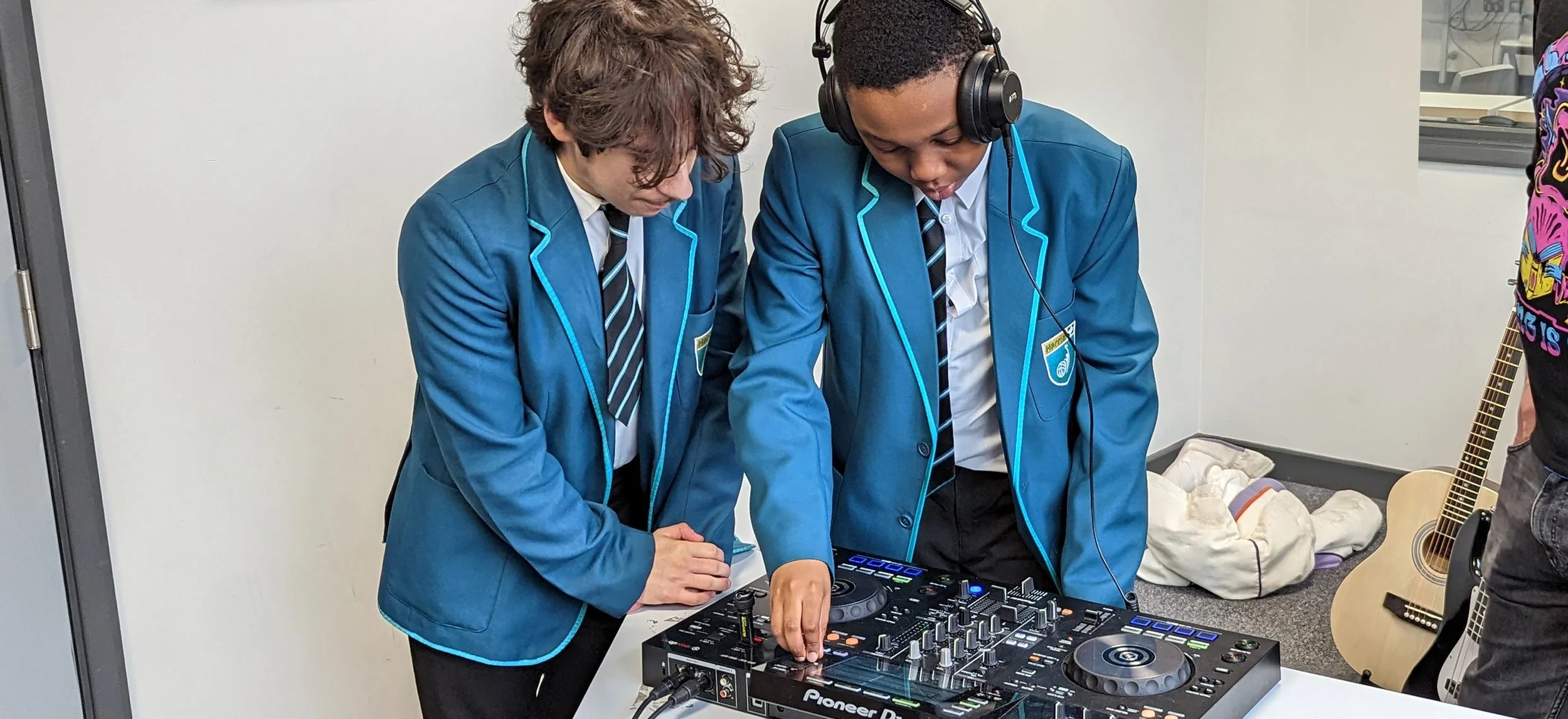
My observation is that many teachers in schools do not have knowledge of DJing or the skills to do it themselves. They are often dependent on visiting peripatetic tutors to bring these skills into their departments. Whilst whole class activities can be supported with some of the cheaper products (e.g. Roland’s DJ-202 or Pioneer’s DJ-FLX2), these are still expensive items to purchase en masse (c. £2500 for a class set of 16 controllers) and also rely on teachers having access to computers or other devices to connect these too. More expensive DJing ‘all in one’ tools such as Pioneer’s DDJ-REV controllers are significantly more expensive (c. £800 upwards). Whilst some schools may purchase one of these, the choice is often dictated by the equipment that their visiting artist or peripatetic teacher is knowledgeable about.
We have noticed a significant shift regarding the perceived value of DJing. This has been helped by the provision of several national, accredited and regulated qualification frameworks from examination organisations such as RSL Awards (Music Practitioners, Levels 1 – 3) and Pearson (BTec Level 3 in Music Technology, which includes a DJ pathway throughout the qualification). These add academic credit to the activity which is a major influence on the decision making of professional educators to include (or not) these activities within their curricula frameworks.
These awards are similar in scope to the traditional instrumental music examinations offered by the ABRSM, Trinity Guildhall and others. Another sign of the growing prevalence and influence of DJing, is that even conservative organisations like the ABRSM have worked in partnership to produce qualifications for DJs alongside their established instrumental qualifications.
If we were to work with a manufacturer to provide a sponsored package of technology to support DJing in education today, it would almost certainly include a class set of basic DJ controllers (e.g. Roland’s DJ-202 or Pioneer’s DJ-FLX2 or FLX4). These would give students a good introduction to DJing. Following on from this, it would be useful for schools to have access to a more powerful ‘all in one’ piece of technology (e.g. something from Pioneer’s DDJ-REV range). Similar products exist in the Numark catalogue too at more preferential price points. Numark products often contain built in speakers and software that allows access to cloud-based resources. These are significant for educators who often do not have the additional budget required for speakers/headphones/tablets or other equipment.
Anecdotally, we have noticed the activity of DJing is exciting, empowering and hugely attractive to young people. It celebrates aspects of their musical culture that is not recognised in other forms of music within the school curriculum. It has strong cross-curricular and interdisciplinary links, particularly with mathematics and numeracy.
More formal research in this area is emerging gradually. Last year, a study from ResearchGate indicated that rhythm-based music training improves students' understanding of fractions significantly more than traditional methods. Within DJing, beatmatching requires an intuitive understanding of ratios and percentages. This study claimed that students with musical/DJ backgrounds outperformed peers in identifying complex numerical patterns (92.5% accuracy vs. 17.5%) (UCL Press, 2025). More generally, the NAfME 2025 study has identified a broader range of educational benefits on students’ cognitive and communicative skill development.
Summary
The rise of DJing in the curriculum represents a vital shift toward a more representative, accessible, and equitable music education. By moving beyond traditional Western notation, DJing dismantles the barriers that often exclude students based on their cultural background or physical ability. For example, the tactile, visual, and rhythmic nature of DJing provides an ideal environment for neurodivergent learners. The use of visual waveforms and immediate auditory feedback supports students with ADHD and dyslexia, offering an alternative language for musical mastery that does not rely on text-heavy instruction.
Ultimately, in the hands of the right teacher, the adoption of DJing as a musical practice can transform the classroom into an inclusive space where every student has the opportunity to curate, create, and communicate their unique identity.
References
National Association for Music Education (NAfME). (2025). The DJ as Educator: Beyond Beats. [Online Blog]. Available at: https://nafme.org/blog/the-dj-as-educator/
ResearchGate (2025). From Notes to Numbers: The Impact of Music Education on Mathematical Skills and Cognitive Development. [Technical Report]. Available at: https://www.researchgate.net/publication/393104888 [last accessed 5/1/26].
